


Gustav Klimt’s Gold: Material Substance, Studio Technique, and the Economics of Illusion
The Myth of “Solid Gold” Paintings
Few artists are as closely associated with gold as Gustav Klimt. His so-called “Golden Phase,” particularly works produced between 1901 and 1909, has fostered a persistent popular belief that his paintings are materially saturated with precious metal. Yet conservation science and museum cataloging reveal a more nuanced reality: Klimt’s “gold” is materially heterogeneous. In The Kiss (1908–09), for example, the Belvedere’s collection record distinguishes between gold leaf in the figural zones and composition gold (brass) in the background, enhanced with glazes and scattered metal flakes. This differentiation is not trivial—it radically alters any calculation of intrinsic metal value.
The distinction between fine gold leaf and brass imitation gold demonstrates that Klimt’s luminosity was achieved not simply through the application of bullion, but through a sophisticated orchestration of metal alloys, layered glazes, and optical engineering. Technical studies of related works—including the Stoclet House cartoons—have confirmed that areas appearing golden may in fact consist of brass (copper–zinc alloy) or Cu/Zn/Au mixtures. Thus, the “gold” in Klimt is both symbolic and strategic: it is as much about perception as it is about material purity.
Key Material Distinctions
-
Gold leaf (approx. 23k)
-
Silver leaf
-
Platinum leaf
-
Composition gold (brass imitation leaf)
-
Gold paint applied over relief (e.g., gesso)
The material reality is therefore far more complex than the aesthetic impression suggests.
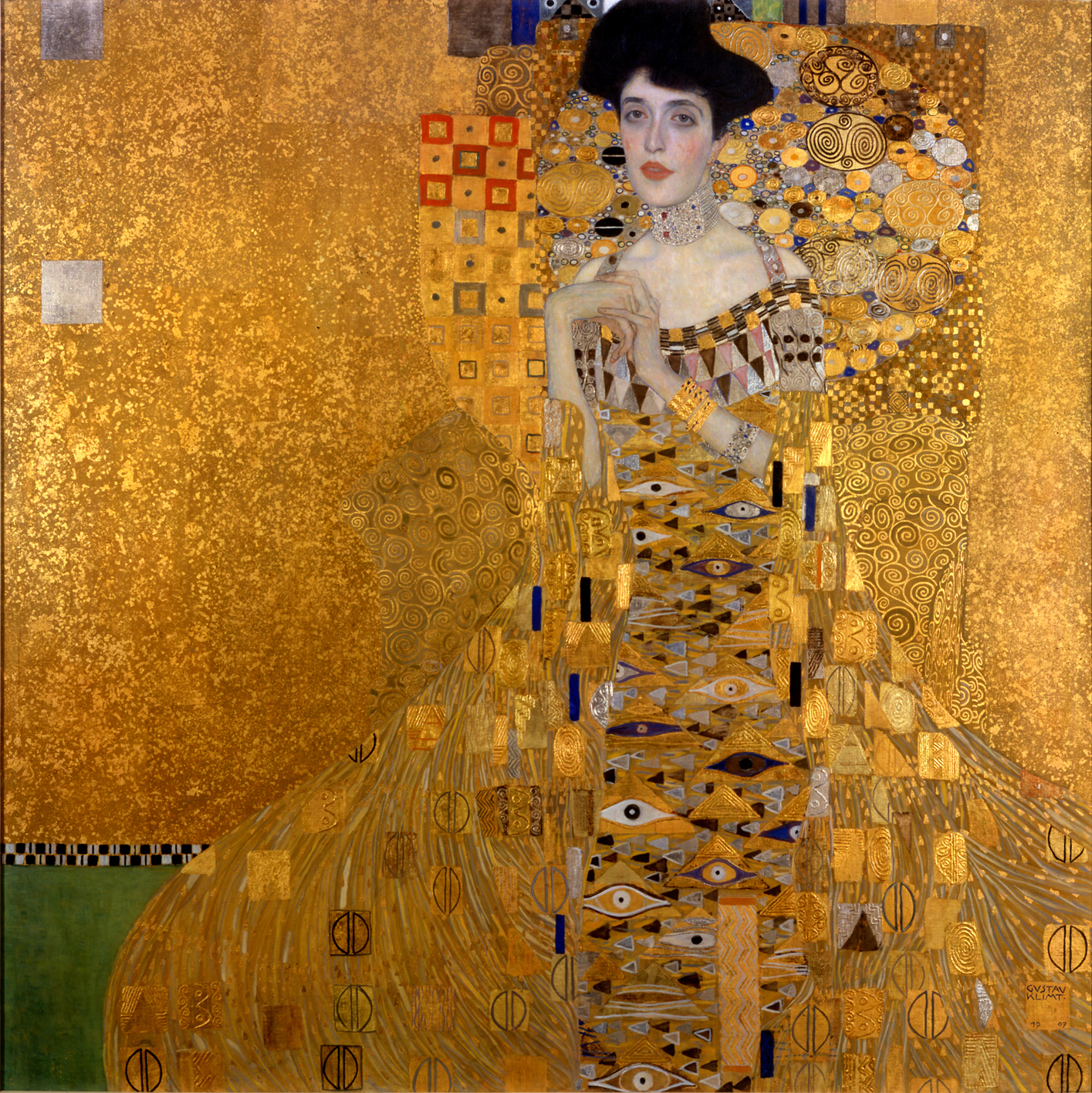
Corpus of Klimt Works Incorporating Gold
Klimt’s use of gold was not isolated to a single masterpiece but appears across multiple major works. However, the type of gold application varies significantly from painting to painting.
Below is a simplified catalog summary of major documented works incorporating gold:
| Work | Date | Documented Gold Use | Location |
|---|---|---|---|
| The Kiss | 1908–09 | Gold leaf (figures); brass composition gold (background) | Belvedere, Vienna |
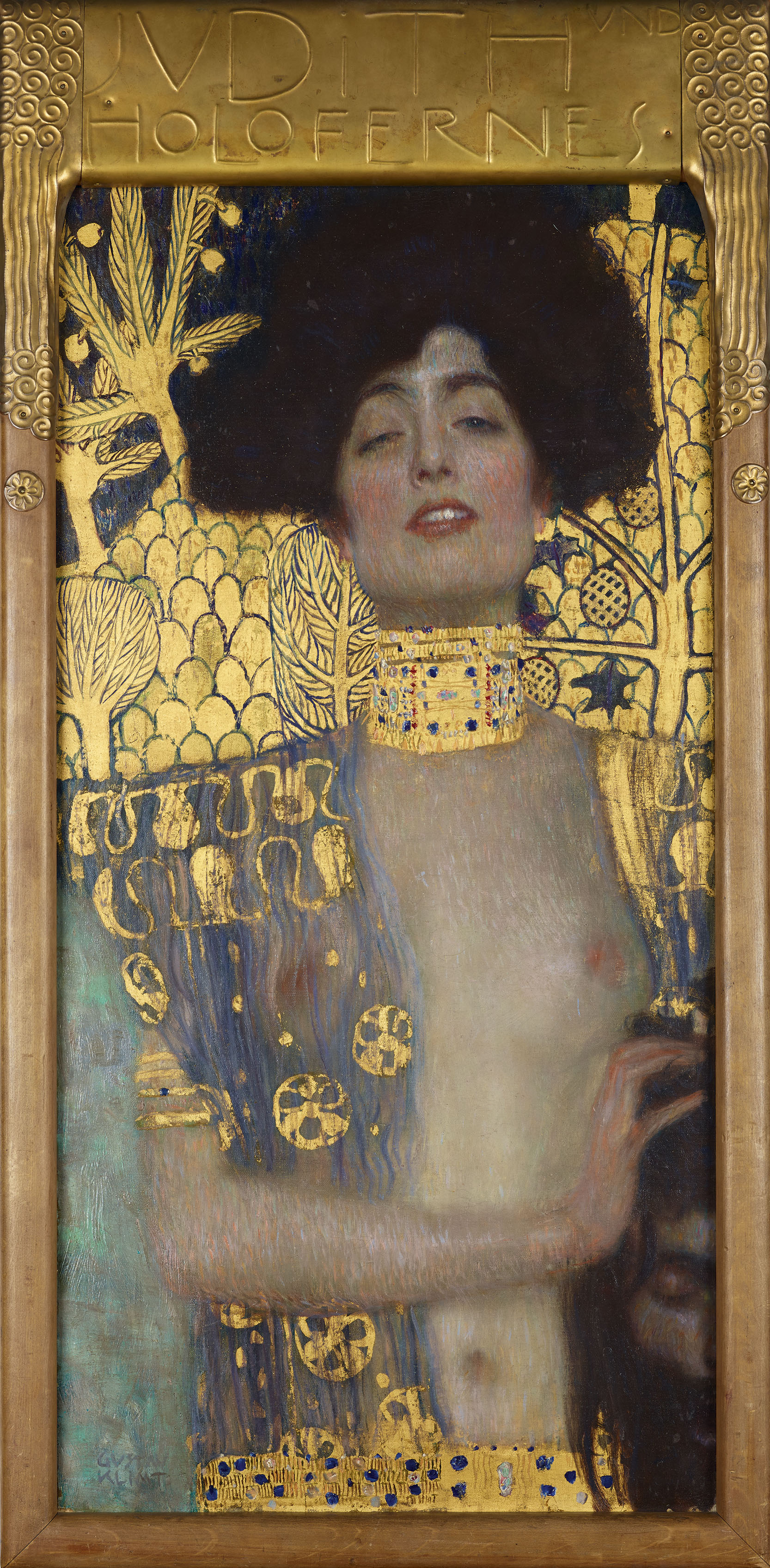
| Judith | 1901 | Oil and gold leaf | Belvedere, Vienna |
| Hope II | 1907–08 | Oil, gold, platinum | MoMA, New York |
| Adele Bloch-Bauer I | 1907 | Gold & silver; gold paint over relief | Neue Galerie, NY |
| Beethoven Frieze | 1901–02 | Gold overlays on mortar | Secession, Vienna |
| Lady with a Lilac Scarf | ca. 1895 | Documented gold leaf plane | KHM, Vienna |
This corpus illustrates that gold appears in multiple material formats: leaf integrated into oil painting, overlays on architectural plaster, and gold paint layered over sculptural gesso relief. It also underscores that Klimt did not rely exclusively on pure gold; instead, he deployed a multi-metal vocabulary calibrated to visual effect and cost efficiency.

How Klimt Applied Gold: Technique and Innovation
One of the most revealing technical findings comes from the Kunsthistorisches Museum’s conservation study of Lady with a Lilac Scarf. Cross-sectional analysis demonstrated that Klimt applied gold leaf directly onto a still-tacky, resin-bound imprimatur—without the use of a traditional oil mordant (adhesive size). This is an important technical deviation from classical gilding practice, where a distinct adhesive layer is typically required.
By timing the application of the leaf to coincide with the optimal tack of the resinous underlayer, Klimt effectively integrated gilding into the painting process itself. The gold leaf thus became a structural event within the paint stratigraphy rather than a decorative afterthought. This approach allowed for greater fluidity between painted and gilded zones and reduced the need for separate craft procedures.
Documented Technical Features
-
Commercially primed canvas (often zinc white ground)
-
Resin–oil hybrid paint systems
-
Resin-bound imprimatur functioning as adhesive
-
Gold leaf pressed into tacky layer
-
Glazing applied over brass “composition gold”
-
Gold paint applied over gesso relief for raised ornament
In The Kiss, Belvedere documentation confirms the presence of gold, silver, and platinum leaf within the figures, while identifying the background as brass imitation gold. This zonal differentiation suggests intentional material hierarchy: precious metals for sacred or intimate human forms; optical alloys for atmospheric expanses.
Quantifying the Gold in The Kiss
Although The Kiss appears visually saturated with gold, the physical mass of gold leaf is surprisingly small due to the extreme thinness of gilding material. Standard gold leaf is approximately 0.1 microns thick and typically around 23 carats (95.8% fine gold).
Using documented painting dimensions (180 × 180 cm), standard physical constants, and conservative assumptions regarding coverage, the baseline calculation yields approximately:
-
Estimated fine gold mass: ~2.41 grams
-
Gold price (Feb 25, 2026): $167.22 per gram
-
Intrinsic gold value: ≈ $404
Even under generous assumptions regarding coverage and thickness, the plausible range remains modest:
| Gold Coverage | Leaf Thickness | Fine Gold Mass | Intrinsic Value (USD) |
| 25% | 0.08 µm | 1.38 g | $231 |
| 35% | 0.10 µm | 2.41 g | $404 |
| 45% | 0.20 µm | 6.21 g | $1,038 |
| 60% | 0.20 µm | 8.28 g | $1,384 |
Even at the upper bound of modeling assumptions, the intrinsic metal value barely exceeds $1,300.
This outcome is not paradoxical; it reflects the extraordinary thinness of gold leaf and the fact that the background—visually dominant—is primarily brass rather than pure gold.

The Artwork Value: Orders of Magnitude Beyond Metal
The market value of Klimt’s paintings operates in an entirely different economic dimension. While The Kiss is not for sale and carries no disclosed insurance figure, auction comparables provide meaningful context.
Recent benchmark results include:
-
Portrait of Elisabeth Lederer (2025): $236.4 million
-
Lady with a Fan (2023): $108 million
Given the unparalleled iconic status of The Kiss, a hypothetical open-market valuation would plausibly fall in the range of $250–$400 million or higher.

Value Comparison
| Concept | Estimate |
| Intrinsic gold value (baseline) | ~$404 |
| Intrinsic gold value (upper range) | ~$1,384 |
| Hypothetical artwork value | ~$250M–$400M+ |
| Approximate multiplier | 100,000×–1,000,000× |
At $300 million divided by $404, the artwork value exceeds the gold value by roughly 743,000 times.
The disparity is structural
The enormous gap between material value and artwork value reflects fundamental economic principles governing cultural assets. Paintings are not priced by input costs but by scarcity, authorship, provenance, institutional validation, and historical centrality.
Several structural drivers explain the disparity:
-
Scarcity: Klimt’s major works are finite and largely museum-held.
-
Canonical status: The Kiss is an emblem of Vienna 1900.
-
Provenance and restitution history in other Klimt works has amplified global attention.
-
Institutional anchoring: Museum ownership removes supply from the market.
-
Cultural symbolism: Gold operates symbolically, not merely materially.
Importantly, conservation evidence shows that even Klimt’s “gold” is often brass, alloy, or gold paint over relief. The economic value is therefore anchored not in commodity metal, but in artistic authorship and cultural meaning.
What Would Improve Measurement Precision?
A definitive quantification of gold in The Kiss would require:
-
High-resolution XRF mapping to distinguish gold from brass.
-
Confirmation of karat purity of leaf used.
-
Determination of whether single or double leaf layers were applied.
-
Conservation documentation of restoration interventions.
Until such technical mapping is published, all calculations remain modeled estimates constrained by catalog disclosures.
Conclusion: Gold as Optics, Not Bullion
Klimt’s genius lies not in the quantity of gold he applied, but in how he transformed minimal grams of precious metal into overwhelming visual and symbolic power. The shimmering surface of The Kiss is an orchestration of resin chemistry, alloy selection, glazes, and layered relief—not a sheet of bullion stretched across canvas.
From a minting perspective, this presents a fascinating inversion: a few hundred dollars’ worth of gold can become the luminous surface of an object valued in the hundreds of millions. The transformation is not alchemical in a metallurgical sense—it is cultural alchemy, where authorship and iconography multiply material value beyond measurable commodity metrics.
For Wessex Mint Academy, Klimt offers a powerful case study in the distinction between intrinsic metal value and cultural capital. Gold may provide the shimmer, but it is the artist’s authorship that provides the fortune.
